
Reflections from our latest workshop
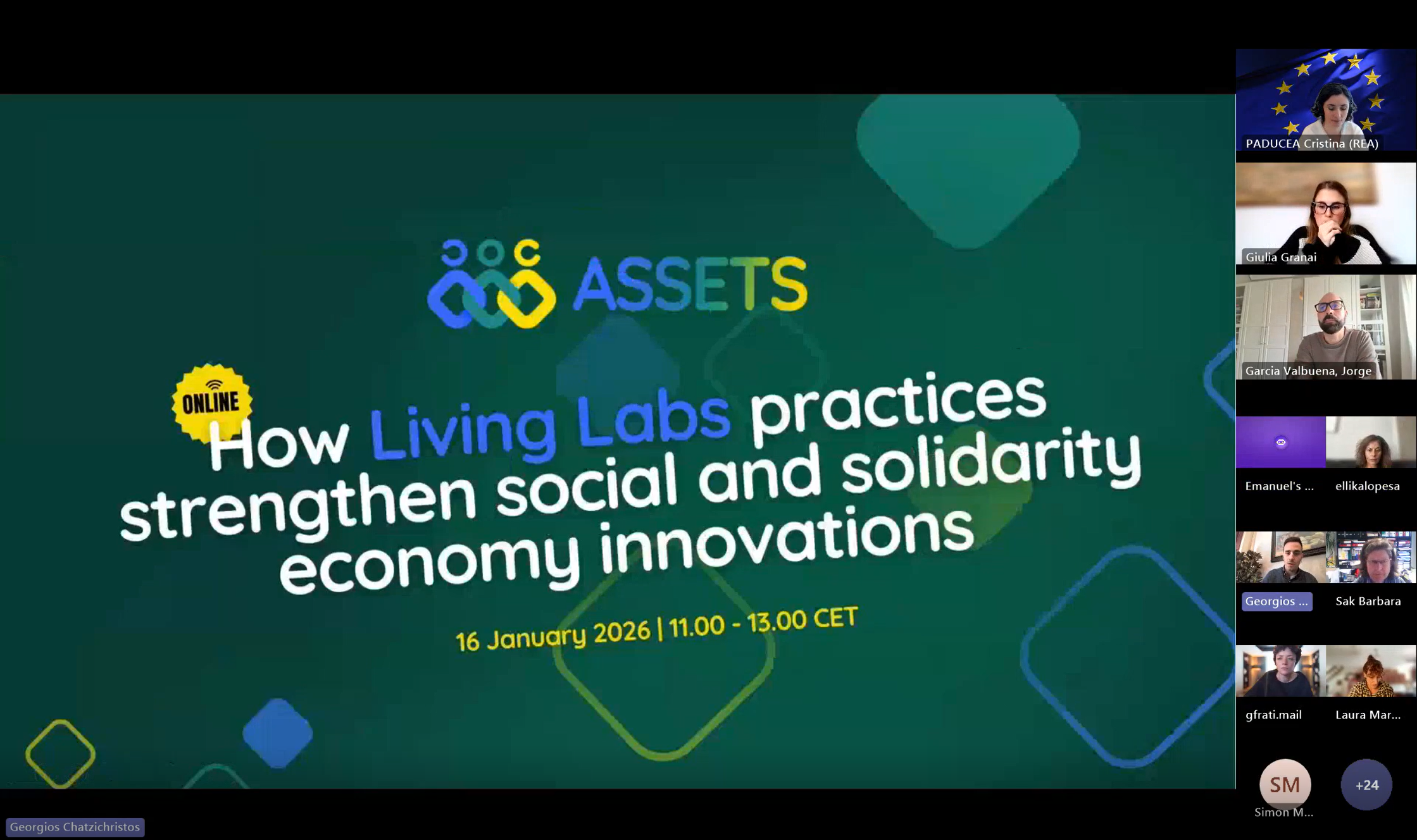
On Friday 16 January, the ASSETs project hosted a workshop facilitated by the P2P Lab, with Laura Martelloni guiding the discussion and exchanges throughout the session.
This explored how co creation and Living Labs can support innovation in the Social Economy across local, national and international contexts. The session brought together researchers and practitioners to reflect on how participatory approaches can strengthen social innovation, improve inclusion and generate sustainable impact.
The discussion focused on how innovation often already exists within communities and ecosystems, but remains fragmented or underused. Living Labs and co creation processes offer practical ways to connect actors, surface existing assets and turn shared challenges into collective solutions.
Insights from the workshop speakers
The workshop featured contributions from:
• Giulia Granai (University of Pisa), who presented work on social farming and job inclusion pathways in Turin, highlighting how local initiatives can support labour market access and social inclusion when embedded in strong community networks.
• Adam Thorpe (University of the Arts London), who shared experiences from participatory placemaking projects in Camden, focusing on how university community collaboration can generate long term social value when residents are involved as equal partners.
• Jorge García Valbuena (Tecnalia Research & Innovation Foundation), who discussed participatory theories of change in the cultural and creative sectors, emphasising the importance of shared ownership and adaptive learning in complex innovation processes.
Key takeaways
Across the different case studies and perspectives, several common themes emerged. Participants stressed the importance of mobilising existing local assets rather than starting from scratch, and of investing time in building trust, strong partnerships and effective ecosystem connectors. These elements were identified as essential foundations for meaningful and lasting impact.
The workshop also underlined the role of participatory approaches in breaking down silos between sectors and stakeholders. By involving communities, practitioners and institutions throughout the process, co creation helps build shared ownership and increases the relevance and resilience of solutions. Mapping needs together and co designing responses were highlighted as critical steps for achieving sustainable change.
Enabling collaboration for impact
A clear takeaway from the discussion was that innovation already exists within our ecosystems. The challenge lies in enabling collaboration, aligning actors and creating the conditions for ideas to scale and endure. Living Labs and co creation offer practical frameworks to do exactly that, supporting more inclusive, grounded and impactful social economy initiatives.
The ASSETS project will continue to explore and share practices that strengthen participatory innovation and contribute to a more resilient and inclusive social economy across Europe.